
The Showdown For Democracy
"Romania VS Extremism" Part 3

Act I - A Controversial Election
November 24, 2024. Millions of Romanians had just cast their vote for the next president of the state. At 52% turnout, it represented a slight improvement from the ones held in 2019, but still mediocre.
As voting booths closed, exit polls were released, and narratives were already being formed as to who would wind up in the second round. To nobody’s surprise, it showed Social Democrats’ Marcel Ciolacu ranking first, with an estimated 24%, and Save Romania Union’s Elena Lasconi taking second place with almost 20% of votes.
However, in third place ranked a figure that many didn’t even know at all. It was Călin Georgescu, and we certainly know more about him than we ever did because of this result.
But the story can’t end here, it needs a plot twist, right? Well, after counting the votes, Romania would get its biggest surprise of the year, as the exit polls were embarrassingly far from reality.
The real winner of the first tour, you might ask?
Călin Georgescu. The independent candidate who polled at around 5% before the vote, campaigned as the man who will bring the nation to its apex once again and promised to end the cost-of-living crisis, as well as cut funding for Ukraine. With 23% of votes, he represented the biggest upset in a Romanian election.
Until he was found guilty of foul play.
Act II - The Constitutional Game
Definitely, such a shocking result mandates some investigation by authorities. And so, they dug deeper into Georgescu’s campaign, to see exactly how he had convinced so many people to vote for him. In actuality, it was a rather simple idea: mass polarization on social media.
This is where Georgescu excelled in his campaign, as no other candidate used the internet as the main tool to promote themselves. By sharing short clips of himself, he managed to gain an audience in a pretty short time. On Tik Tok, his accounts grew to over 600,000 followers with 7.2 million likes on his posts. Now, was this organical growth? Well, some of it was, but it was later found that especially in the beginning, his posts were being pushed by bot accounts who reposted his clips, a method used especially for online scams.
However, this wasn’t the only thing wrong with Georgescu’s campaign. While some big names had thousands of euros poured into the race, Georgescu reported no contributions for his campaign. Authorities later found that certain accounts supported him through donations on Tik Tok livestreams, with as much as €1 million being raised like this. The state’s suspicion was that this was a coordinated attack on the integrity of Romanian elections by an outside force, and the general consensus was Russia, as in his speeches Georgescu confirmed his pro-Russian views.
On December 4th, the Constitutional Court reunited to discuss the validity of the elections. The verdict? No foreign intervention, which meant the second round would start on December 8th, between Călin Georgescu and Elena Lasconi.
Not if someone did something about it.
Another two days after the initial verdict by the Constitutional Court, the president of Romania, Klaus Iohannis, declassified the document that described everything you’ve read in the last two paragraphs and even more to the public.
The reaction was mental, and the nation was split. It was either a way to preserve fair elections, or a last-ditch effort to block Georgescu from seriously competing for President.
Nevertheless, the Constitutional Court immediately declared the first round of elections unconstitutional, now citing foreign interference and annulling it.
Act III - The Aftermath
Internally, it was a crisis: extremist groups in Parliament were accusing the courts and the government of preventing Georgescu, the rightful winner, from advancing to the second round. Thus, the infamous slogan “Turul doi, înapoi!” (“Second round, bring it back!”) was starting to be heard in the streets.
Investigating Georgescu even more, prosecutors charged him with tampering of elections, as well as supporting fascist groups and personalities. In his interviews, he had stated that he holds high admiration for dictator Ion Antonescu, a fascist leader who was responsible for the deaths of over 250,000 Jews and Roma people during WW2, and Corneliu Zelea Codreanu, the leader of the legionary paramilitary organization called the Iron Guard.
This, as well as his close connection to wanted legionary mercenary leader Horațiu Potra was enough to build a solid case against Georgescu, who was placed on judiciary control and banned him from leaving the country, as well as creating new social media accounts.
The outcry for the annulment of the first round had reached far beyond Romanian borders, as it was the first time in European history that an election was canceled due to foreign intervention in the democratic process. On one side, world leaders defended the decision, like Ursula von der Leyen, who promised to investigate Tik Tok for pushing clips of Georgescu on the algorithm, while Donald Trump Jr., J. D. Vance and Elon Musk blasted the Constitutional Court for not respecting “the will of the Romanian people”.
Well, what now?
A new president would still have to be chosen, so the government officially announced the month of May as the month of election campaign, with the first round starting on May 4th.
Act IV - Rise Of An Underdog
After the crumbling of the Liberal-Social Democrat coalition, it was Crin Antonescu, a former Head of Senate and interim President, who came out of retirement to run as the establishment’s candidate.
Once Save Romania Union’s main hope, Elena Lasconi reportedly had a falling-out with the party after the annulment of the first round, with polls showing her at only 8%.
On the other side, Georgescu’s candidacy was rejected by the Constitutional Court because of last elections’ problems, with both George Simion and Victor Ponta running in his place.
However, in Bucharest, something was brewing.
The capital’s mayor, Nicușor Dan, announced his candidacy for president after multiple NGOs and personalities asked for him. Polling at 20%, he released the ”Honest Romania” program, detailing reforms, the economy, foreign policy and social issues, coming at 60 essential points. Though independent, he received support from the Save Romania Union, a party that he himself founded in 2016.
On the day of the first round, tensions were high. At the final count of votes, Simion was shown to win an astonishing 41%, while Nicușor’s 21% barely managed to separate him from Antonescu, who had 20% of votes.
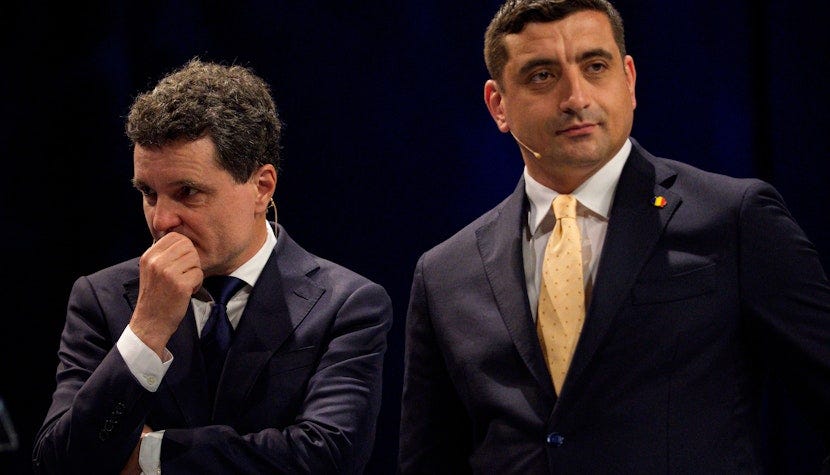
The final was set: Nicușor Dan versus George Simion, pro-Europeanism versus pro-Russianism, the center versus the far-right.
A last showdown for democracy.
Act V - Democracy, Protected?
The lead up to the most anticipated event of the year in Romanian politics was nothing short of controversy. In the two weeks that were before the second round, multiple debates were scheduled between the two candidates. However, they met in only one of them. Intense battles were being fought every day on the internet between supporters, who had been divided into two very distinct camps.
Unlike Nicușor, who attended every debate as per schedule and answered questions regarding his campaign, Simion decided to abandon them after his unfavorable result in his first debate, choosing to fly to different countries to garner support in the diaspora, gain endorsements from foreign politicians and badmouth his countercandidate.
The two attitudes really showed the contrast between who they were as candidates, and when voting closed, it would show whose strategy worked better.
Exit polls were inconclusive, as they were made without taking the diaspora into consideration. However, it showed Nicușor narrowly beating Simion with 54% to 45%.
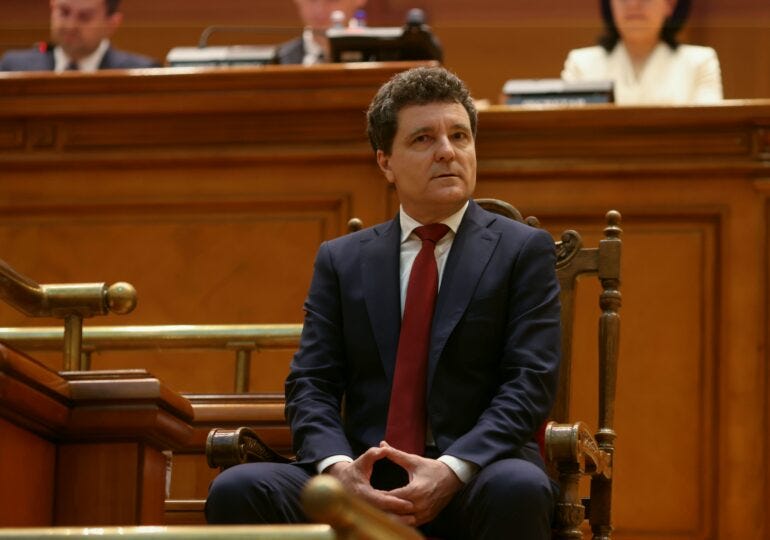
What followed was millions of people staying up late to watch the votes being counted in real time, and exactly at midnight, on the 19th of May, NIcușor Dan was officially elected the 7th President of Romania.
Despite Simion later disputing the result, it was certified by the Constitutional Court, and Nicușor took his oath a week later, on the 26th of May.
A Saga Finale
Now that we are at the end, we would like to hear your thoughts. Was the first round rightfully annulled in 2024? Should Călin Georgescu have deserved to become president, or did the state install Nicușor Dan as President to protect their interests?
We await discussion in the comment section.
This marks the end of our walkthrough of Romanian extremist political history, from its first appearance right after the 1989 Revolution and Vadim Tudor’s PRM, to the revival of the far-right sentiment in time for the pandemic, which helped boost George Simion’s AUR to the top of Parliament. And again, the extremists will still have to wait until they are in power. Maybe one day they will be, and that will be an interesting day.
Thank you for your time and attention, subscribe to support Inside Romania!